> ## Documentation Index
> Fetch the complete documentation index at: https://comfytv.org/llms.txt
> Use this file to discover all available pages before exploring further.
# Score Editor
> A beat-domain piano-roll editor. Draw, step-enter and edit notes across up to four parts, then export a MusicXML score.
 ## What this node does
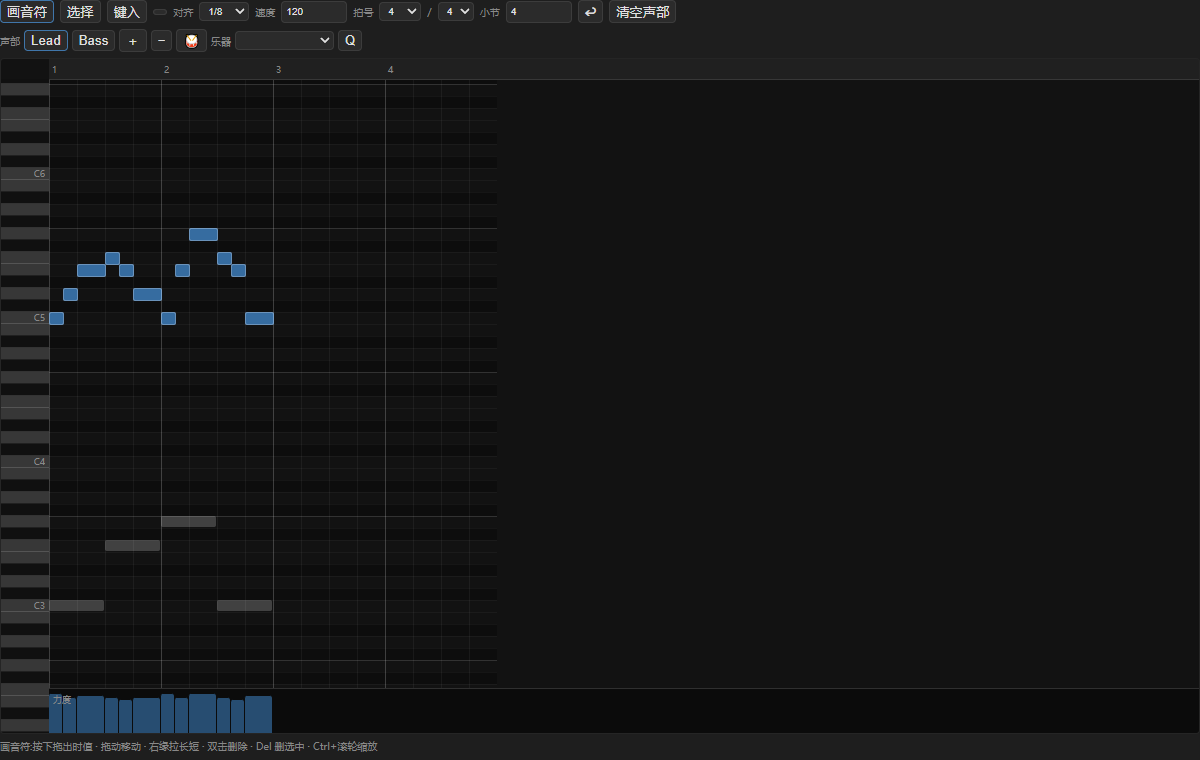
**Score Editor** is a full in-browser piano roll for composing directly on the
canvas. Instead of writing MusicXML by hand (as with the **Score** stage), you
draw notes on a grid measured in **beats and bars**, organize them into up to
four named parts (each with its own instrument or a percussion mode), and set
the tempo and time signature. Everything you draw is stored on the node.
Press **▶ Run** to convert your roll into MusicXML on the backend; the `score`
output is a `COMFYTV_TEXT` MusicXML document ready for **Score Performer**,
**Score Synth**, or any music stage. Running with an empty roll fails with "the
piano roll is empty".
You can also import a wired score (`score` input, `COMFYTV_TEXT`) into the roll
to edit an existing piece.
## The editor
The card is a toolbar-plus-piano-roll. From top to bottom:
**Tool row.**
* **Draw / Select / Step** — the three editing modes.
* *Draw*: click-drag on the grid to create a note; the drag sets its length,
and the note beeps as you place it.
* *Select*: drag a marquee to select notes (Shift adds to the selection);
click a note to grab it.
* *Step*: enter notes one at a time with the keyboard at a moving cursor —
press a letter key **A–G** to insert that pitch, **0** or **Space** for a
rest, **Backspace** to delete the last step, and arrow keys to transpose
(Up/Down, Shift for octaves) or move the cursor (Left/Right). In Step mode a
duration picker appears (**1, 1/2, 1/4, 1/8, 1/16, 1/32**) plus a dotted
toggle (**·**); a yellow cursor line marks the insert point.
* **Play (▶ / ■)** — plays the whole roll with a built-in oscillator/drum
synth; a green playhead sweeps across and the view auto-scrolls to follow.
* **Snap** — grid snapping: **1/4, 1/8, 1/16, 1/32,** or **free**.
* **Tempo** — BPM (20–400).
* **Time sig** — beats-per-bar (1–12) over beat-type (2, 4 or 8).
* **Bars** — total length in bars (1–256).
* **Undo (↩)**, **Clear part**, and (when a score is wired) **Import score**.
**Part row.**
* Buttons for each **part** (up to four); click to make one active, double-click
to rename. **+ / −** add or remove parts.
* **🥁 Percussion** toggles the active part to a drum lane — the keyboard on the
left switches to General MIDI drum names instead of pitches.
* **Instrument** — a General MIDI instrument dropdown for the active
(non-percussion) part.
* **Q Quantize** snaps the selected notes to the grid.
* Import status/warnings appear here (e.g. skipped percussion on import).
**Piano roll.** A scrollable grid with a piano keyboard down the left edge
(click a key to audition its pitch; C notes are labelled). Notes are blocks you
can:
* **move** by dragging the body,
* **resize** by dragging the left or right edge handle,
* **delete** by double-clicking,
* multi-select and drag/resize together.
Notes in other (inactive) parts show as dim "ghost" blocks so you can align
against them. A **velocity lane** runs along the bottom — drag across it to
paint the loudness of the notes under the cursor.
**Zoom & navigation.** Ctrl/Cmd + mouse wheel zooms the beat grid; scroll bars
pan. Keyboard shortcuts: **Delete/Backspace** removes selected notes,
**Ctrl/Cmd+Z** undoes, **Ctrl/Cmd+A** selects all, **Ctrl/Cmd+D** duplicates
the selection.
## Workflow / step by step
1. Set **Tempo**, **Time sig** and **Bars** for the piece.
2. Pick a **Snap** value; choose or add a **part** and set its **Instrument**
(or toggle 🥁 for drums).
3. **Draw** notes (or use **Step** mode to type them in); adjust length with the
edge handles.
4. Add more parts for other instruments; use the ghost notes to line them up.
5. Shape dynamics in the **velocity lane**; press **Play** to audition.
6. Press **▶ Run** to emit the MusicXML **score**, then wire it to **Score
Performer** / **Score Synth**.
## Inputs and outputs
| Slot | Dir | Type | Meaning |
| --------- | ------------- | -------------- | -------------------------------------------------- |
| **score** | in (optional) | `COMFYTV_TEXT` | An existing MusicXML score to import into the roll |
| **score** | out | `COMFYTV_TEXT` | The MusicXML built from your roll |
The roll itself is stored on the node in a hidden `notes_json` field, so your
work is saved with the workflow.
## Tips
* **Step mode** is the fastest way to enter melodies precisely: set the
duration, then type note letters — no dragging.
* Use the **ghost notes** from other parts as a reference when writing
counterpoint or harmony.
* Percussion parts use drum names on the keyboard; importing a score skips
percussion parts (you'll get a warning if any were dropped).
* Nothing reaches downstream until you press ▶ Run — the roll is the editor, the
run emits the score.
## Related nodes
* **Score** — the MusicXML-first alternative (paste XML instead of drawing).
* **Score Performer** — performs your exported score with feel and outputs MIDI.
* **Score Synth** — renders it to audio.
* **MIDI Editor** — the seconds-domain piano roll for MIDI files (not MusicXML).
* **Bridge** — convert to/from native ComfyUI types. See
[https://github.com/jtydhr88/ComfyTV/blob/main/docs/bridges.md](https://github.com/jtydhr88/ComfyTV/blob/main/docs/bridges.md)
## What this node does
**Score Editor** is a full in-browser piano roll for composing directly on the
canvas. Instead of writing MusicXML by hand (as with the **Score** stage), you
draw notes on a grid measured in **beats and bars**, organize them into up to
four named parts (each with its own instrument or a percussion mode), and set
the tempo and time signature. Everything you draw is stored on the node.
Press **▶ Run** to convert your roll into MusicXML on the backend; the `score`
output is a `COMFYTV_TEXT` MusicXML document ready for **Score Performer**,
**Score Synth**, or any music stage. Running with an empty roll fails with "the
piano roll is empty".
You can also import a wired score (`score` input, `COMFYTV_TEXT`) into the roll
to edit an existing piece.
## The editor
The card is a toolbar-plus-piano-roll. From top to bottom:
**Tool row.**
* **Draw / Select / Step** — the three editing modes.
* *Draw*: click-drag on the grid to create a note; the drag sets its length,
and the note beeps as you place it.
* *Select*: drag a marquee to select notes (Shift adds to the selection);
click a note to grab it.
* *Step*: enter notes one at a time with the keyboard at a moving cursor —
press a letter key **A–G** to insert that pitch, **0** or **Space** for a
rest, **Backspace** to delete the last step, and arrow keys to transpose
(Up/Down, Shift for octaves) or move the cursor (Left/Right). In Step mode a
duration picker appears (**1, 1/2, 1/4, 1/8, 1/16, 1/32**) plus a dotted
toggle (**·**); a yellow cursor line marks the insert point.
* **Play (▶ / ■)** — plays the whole roll with a built-in oscillator/drum
synth; a green playhead sweeps across and the view auto-scrolls to follow.
* **Snap** — grid snapping: **1/4, 1/8, 1/16, 1/32,** or **free**.
* **Tempo** — BPM (20–400).
* **Time sig** — beats-per-bar (1–12) over beat-type (2, 4 or 8).
* **Bars** — total length in bars (1–256).
* **Undo (↩)**, **Clear part**, and (when a score is wired) **Import score**.
**Part row.**
* Buttons for each **part** (up to four); click to make one active, double-click
to rename. **+ / −** add or remove parts.
* **🥁 Percussion** toggles the active part to a drum lane — the keyboard on the
left switches to General MIDI drum names instead of pitches.
* **Instrument** — a General MIDI instrument dropdown for the active
(non-percussion) part.
* **Q Quantize** snaps the selected notes to the grid.
* Import status/warnings appear here (e.g. skipped percussion on import).
**Piano roll.** A scrollable grid with a piano keyboard down the left edge
(click a key to audition its pitch; C notes are labelled). Notes are blocks you
can:
* **move** by dragging the body,
* **resize** by dragging the left or right edge handle,
* **delete** by double-clicking,
* multi-select and drag/resize together.
Notes in other (inactive) parts show as dim "ghost" blocks so you can align
against them. A **velocity lane** runs along the bottom — drag across it to
paint the loudness of the notes under the cursor.
**Zoom & navigation.** Ctrl/Cmd + mouse wheel zooms the beat grid; scroll bars
pan. Keyboard shortcuts: **Delete/Backspace** removes selected notes,
**Ctrl/Cmd+Z** undoes, **Ctrl/Cmd+A** selects all, **Ctrl/Cmd+D** duplicates
the selection.
## Workflow / step by step
1. Set **Tempo**, **Time sig** and **Bars** for the piece.
2. Pick a **Snap** value; choose or add a **part** and set its **Instrument**
(or toggle 🥁 for drums).
3. **Draw** notes (or use **Step** mode to type them in); adjust length with the
edge handles.
4. Add more parts for other instruments; use the ghost notes to line them up.
5. Shape dynamics in the **velocity lane**; press **Play** to audition.
6. Press **▶ Run** to emit the MusicXML **score**, then wire it to **Score
Performer** / **Score Synth**.
## Inputs and outputs
| Slot | Dir | Type | Meaning |
| --------- | ------------- | -------------- | -------------------------------------------------- |
| **score** | in (optional) | `COMFYTV_TEXT` | An existing MusicXML score to import into the roll |
| **score** | out | `COMFYTV_TEXT` | The MusicXML built from your roll |
The roll itself is stored on the node in a hidden `notes_json` field, so your
work is saved with the workflow.
## Tips
* **Step mode** is the fastest way to enter melodies precisely: set the
duration, then type note letters — no dragging.
* Use the **ghost notes** from other parts as a reference when writing
counterpoint or harmony.
* Percussion parts use drum names on the keyboard; importing a score skips
percussion parts (you'll get a warning if any were dropped).
* Nothing reaches downstream until you press ▶ Run — the roll is the editor, the
run emits the score.
## Related nodes
* **Score** — the MusicXML-first alternative (paste XML instead of drawing).
* **Score Performer** — performs your exported score with feel and outputs MIDI.
* **Score Synth** — renders it to audio.
* **MIDI Editor** — the seconds-domain piano roll for MIDI files (not MusicXML).
* **Bridge** — convert to/from native ComfyUI types. See
[https://github.com/jtydhr88/ComfyTV/blob/main/docs/bridges.md](https://github.com/jtydhr88/ComfyTV/blob/main/docs/bridges.md)